MARKET TALK: The other side of the digital storm
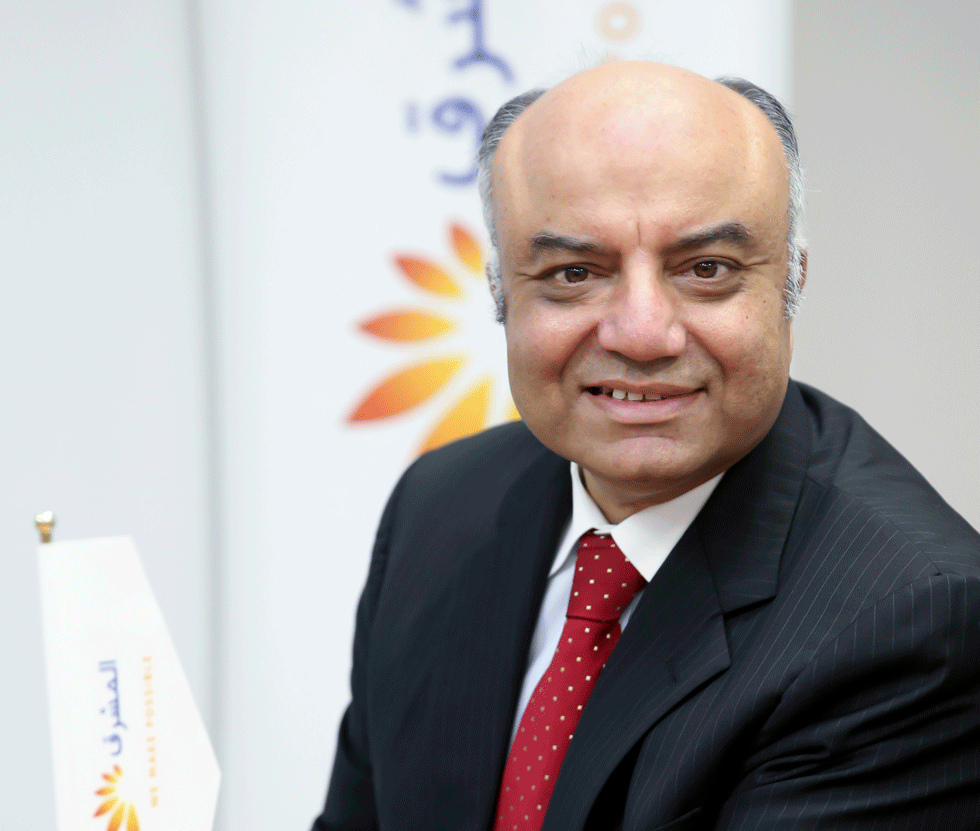
Sandeep Chouhan, executive vice-president and group head of operations and technology at Mashreq, explains how digital technology is transforming the way we bank
What is the impact of Big Data and digital technology on the banking sector?
“We are in the midst of a digital storm. Several strands of technology evolution have emerged over the past three to five years – in analytics, robotics, mobility, cloud computing, payments.
“All of these new technologies are coming in on the service layer of banking and they are extremely easy to adapt into the banking eco system.
“These technologies help us to meaningfully transform the service experience we give to our customers and significantly change the cost efficiency we need to run a profitable enterprise.”
So are banks now competing on their technological capability?
“The competition is always about the quality of insight and the relationship with the customer. That is not going to change.
“These technologies are largely to take away the mechanistic work that is done. In a few years’ time, once these technologies become commonplace, the competition will be around the personalised nature of the service.”
What does this technological change mean for the way banks operate?
“At Mashreq, we started embracing this latest wave of digital transformation about two years ago and have put in place fairly robust infrastructure on robotics and artificial intelligence.
“We have close to 300 robots performing more than 100,000 transactions every day.
“Over these two years, we have built an inventory of digitalised processes such as account opening, fund transfers, statement requests, chequebook requests, trade finance and so on.
“Based upon shifting demand, we have to rebalance these robotic workers.”
How is a workforce of robots managed?
“It’s a new paradigm. Over time, we have learned and are beginning to mature in managing a digital workforce.
“We have robotic command centres supervised by humans. Digital workers also make mistakes; it’s just that they make fewer mistakes – so they have to be trained like human workers.
“There is a shift in utilisation. With a human workforce, the utilisation is an eight-hour working day.
“With digital workers you have the ability to maximise a 24-hour working day and get the highest level of output.”

How are governments keeping up with the pace of digital transformation in financial services?
“We are very fortunate in the UAE as the government is very forward thinking.
“The regulators are constantly revising and reinventing the regulations to allow for the adoption of these new technologies and operating models.
“The most important element is data privacy. The regulations are evolving in line with the arrival of technologies that allow data exchange.
“Governments are putting significant support structures in place to deal with cyber security. So a very significant national infrastructure exists that is keeping itself attuned with the global emerging trend of threat actors at the national stage.
“We’ve seen a lot of emerging global threats around cyber incidents, particularly pertaining to Swift. And I think the region has been particularly rapid to respond to that. Of course, it’s a constantly evolving landscape.”
Will cryptocurrencies and blockchain technology change everyday banking?
“Cryptocurrencies have not yet hit the mainstream and the regulators are looking at it very cautiously. But the underlying technology, blockchain, holds a lot of promise.
“The ability to share information in a secure manner between entities is a long-standing problem that this technology has the promise to solve.”
What will that mean for customers?
“You will see a real difference. Your personal details will sit in one common repository, for example. And you will not need to supply banks and entities with your credentials on a repetitive basis.
“So, almost like a bureau, there will be a central exchange that holds your credentials – not just your personal credentials, but for your transactions, critical commercial documentation and so on.
“Everything then becomes a single reference. Through your ID, I can get this information as a service. You can keep it updated at all points in time.
“The difference between blockchain and central servers is fundamental. With blockchain, information is far more distributed. And because it’s more distributed, it is more secure.
“It is harder to tamper with than if it was in a centralised place. It is called a distributed ledger and that’s the power of blockchain.”
What will banking look like to customers in five or 10 years from now?
“Today, very little transactional and financial insights are available to customers. In the next three to five years, we will see corporations and consumers feeling truly in control of the financial services they receive from banks and able to take far more intelligent decisions, personalised to the business they perform.
“Consumer customers will shift significantly to self-service. And we will have far more flexibility in purchasing elements of financial services from different banks.
“The concept of universal banks may disappear with the convergence of specialist fintechs with classical banks. This means you will have somebody who is offering an excellent lending solution.
“Somebody else with a credit card solution. Somebody else offering an investment solution. The banks of the future will aggregate the best of these services and bring them to the customer.”
And what will the future of corporate banking look like?
“Corporate customers are going to see a far deeper integration with banks. We are seeing the arrival of an open platform.
“We are going to see far more business intelligence and data insights offered to customers than what we see today.
“So, that’s where the future is. It is more personalised. More transparent. And hopefully, more instant in delivering.”
Strategic thoughts
-
Once digital technologies become commonplace, banking competition will be around the personalised nature of the service
-
There are many potential applications for blockchain technology, but it is still in its infancy
-
Banks of the future will aggregate the best services in the market to bring them to the customer
-
Corporate customers are going to see a far deeper integration with the banks they deal with
Watch here the full market talk video