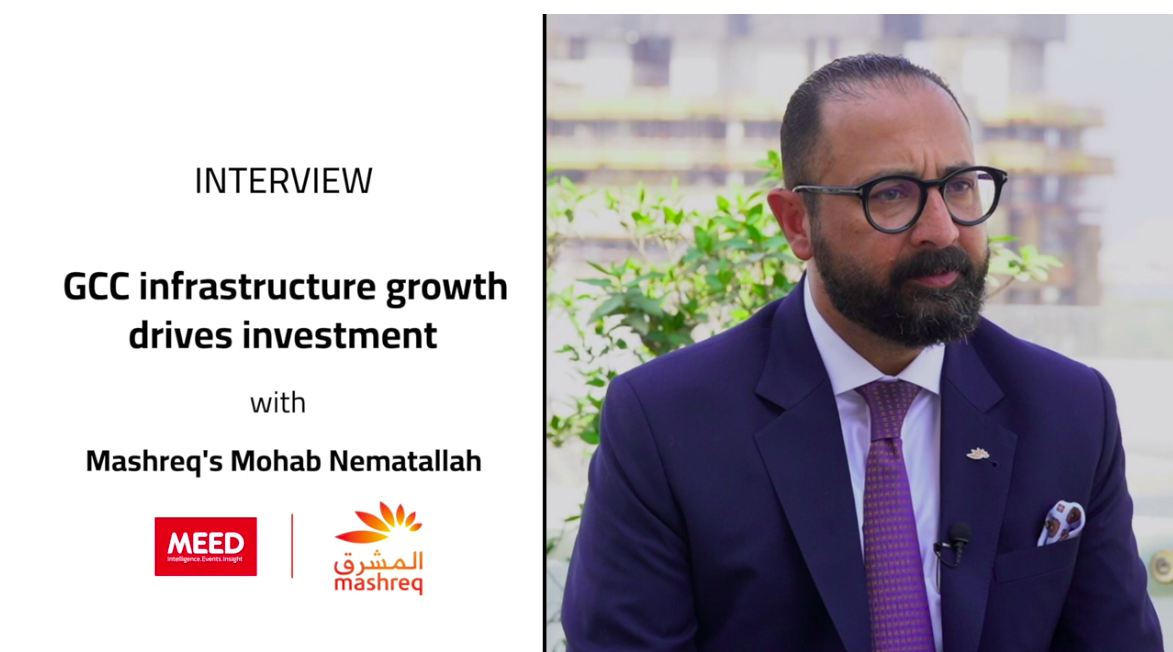
Watch: Infrastructure expansion highlights the region’s long-term potential
Senior vice president and head of public sector at Mashreq, Mohab Nematallah, comments on how evolving funding models and rising private sector participation are propelling infrastructure growth
Across the region, a new phase of infrastructure development is taking shape. Real estate activity has accelerated in recent years, driven by population growth and the rise of integrated mixed-use communities.
In response, governments are scaling up investment in transport and utility infrastructure, progressing new roads, rail networks, airports, drainage systems and power and water projects that can support the next stage of urban expansion.
According to regional project tracker MEED Projects, activity in the GCC’s core infrastructure sectors has expanded sharply in recent years, with awards rising from $32.9bn in 2020 to nearly $124bn in 2024. Over the 2020-25 period, the region awarded more than $ 383 bn in contracts.
The UAE continues to drive much of this momentum. UK analytics firm GlobalData forecasts that the country’s construction market is expected to record growth of 5.2% this year, driven by government-backed spending in utilities, transport and energy.
Foreign investment is reinforcing this drive. According to EY, the number of foreign direct investment (FDI) projects in the GCC rose to 1,973 in 2024, up from 1,929 the previous year, reflecting the Gulf’s appeal as a growth-oriented destination supported by strong infrastructure and sovereign-led city-building initiatives.
For Mohab Nematallah, senior vice president and head of public sector at Mashreq, the combination of domestic investment and rising foreign capital reflects a structural shift in confidence. “The region continues to remain on a growth trajectory, attracting FDI, attracting capital, and that over time would benefit the entire region, provided there’s the right regulatory and government framework,” he says.