How the GCC is responding to a shifting trade landscape
As conflict adds cost and complexity to trade across the Middle East, companies and banks are turning to established financing tools to keep goods and capital moving through a period of uncertainty.
The Middle East remains one of the world’s most active and commercially significant trading regions. Its role as a link between Asia, Europe and Africa has not changed, but the conditions under which goods move through the region have become more complex, and the impact extends beyond companies operating directly in areas affected by the conflict.
Today, businesses are adjusting supply chains, building inventory and seeking greater certainty around payments, all of which are increasing the importance of innovative trade finance and working capital solutions.
Exporters based in the region, businesses selling into GCC markets and companies moving goods through Gulf ports are all having to account for changing routes, higher costs and greater volatility. For businesses, the challenge is not simply to keep goods moving. It is to manage the financial implications of doing so.
The Middle East, and Dubai in particular, has a long-established track record of navigating periods of disruption. The UAE and wider GCC demonstrated during the COVID-19 pandemic that shocks can be absorbed and followed by a strong recovery.
But resilience depends on more than restoring activity once conditions improve. It also depends on whether businesses can maintain liquidity and continue financing trade while conditions remain uncertain.
The pressure is already visible in payment cycles. According to the Allianz Trade Global Survey 2026, the share of companies being paid within 30 days has fallen from 10% to 7% since the conflict began, while the proportion waiting more than 70 days has increased from 15% to 24%. Companies remain willing to trade, but the time between delivering goods and receiving payment is becoming longer, adding pressure on working capital and increasing the importance of financing structures that can help businesses manage that gap.
How businesses are adapting
According to the Allianz survey, building inventory and diversifying into new markets were the two most common responses, each adopted by 64% of firms, followed by sourcing from new suppliers at 63% and rerouting through third markets at 57%. This shift is most pronounced among businesses with longer, more complex supply chains, where greater exposure is driving a stronger push to diversify sourcing and trade routes.
But resilience comes at a cost. Holding additional inventory ties up working capital, new supplier relationships can require different payment arrangements, and rerouting goods through alternative markets can increase logistics and insurance costs. These consequences are particularly significant when payment cycles are already extending.
Yet the survey also suggests businesses are not changing their longer-term direction. Companies continue to pursue strategies such as reshoring and supply-chain diversification, indicating that the current period is being treated as a challenge to manage rather than a reason to abandon broader plans. The objective for most businesses is not to withdraw from international trade, but to build sufficient flexibility to continue participating in it.
Where trade finance steps in
This is where the role of financial institutions becomes more significant. Trade finance has traditionally provided the mechanisms that allow companies to manage the financial risks of buying and selling goods. Letters of credit and guarantees, for example, help provide greater certainty around payments and contractual obligations. The instruments themselves are not new. What is changing is the environment in which they are being used.
Longer trade routes, changing suppliers and extended payment cycles can all increase the amount of capital tied up in the supply chain. Supply chain finance helps manage some of that pressure by improving the flow of working capital between buyers and suppliers, allowing companies to adapt without placing the full financial burden on their own balance sheets.
The wider policy response matters here too. PwC’s Middle East Economy Watch has highlighted measures taken by central banks in Bahrain, Kuwait, Qatar and the UAE to support liquidity conditions and capital requirements, and the UAE and Bahrain agreed a $5.4bn currency swap arrangement to support liquidity at the national level.
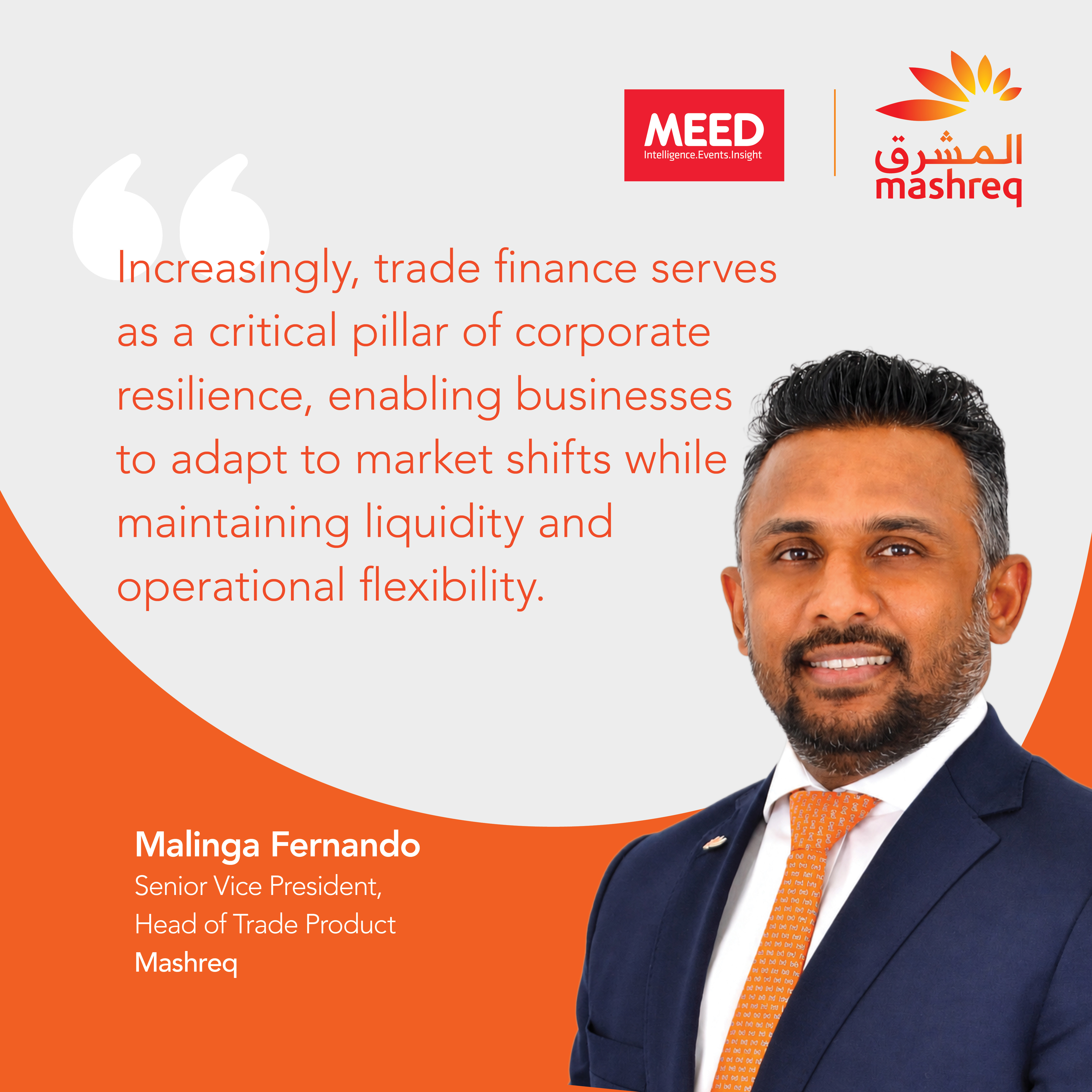
At the corporate level, banks play a complementary role, providing working capital solutions to help businesses manage the financial implications of changing how and where they trade. “Increasingly, trade finance serves as a critical pillar of corporate resilience, enabling businesses to adapt to market shifts while maintaining liquidity and operational flexibility,” says Malinga Fernando, senior vice president and head of trade product for Global Transaction Banking at Mashreq.
Role of Islamic finance in trade
Fernando highlights how Islamic finance has long been an established component of the region’s banking and trade ecosystem, with Shariah-compliant structures widely used to support trade finance, working capital, and cross-border commercial activities.
“While it is not a direct response to current geopolitical pressures, its principles of asset-backing and risk-sharing continue to provide businesses with an effective and resilient financing framework in an increasingly complex global trade environment,” he adds.
It forms part of the financial infrastructure through which many businesses in the region operate, and that role is likely to remain significant. Financial intelligence corporation S&P Global expects the global Islamic finance industry to grow by 5% to 10% in 2026, despite a more challenging economic backdrop.
Sustainability and trade finance
The immediate priority for companies navigating uncertainty is to maintain supply chain continuity and protect liquidity, but the decisions being made to strengthen resilience can also carry longer-term environmental and social implications. Diversifying suppliers can reduce dependence on a single market, but changing sourcing patterns may alter the environmental footprint of logistics. Rerouting goods offers an alternative to disrupted routes while increasing transport distances, and building additional inventory provides a buffer against delays at the cost of additional warehousing and resources.
There are signs these themes are beginning to converge within Islamic finance. Data cited in The Asset’s Islamic Finance Awards coverage shows that environmental, social and governance (ESG)-labelled sukuk issuance reached a record $23.8bn in 2025, up 54% year on year, with a further $2.2bn issued in the first four months of 2026 and Saudi Arabia accounting for more than 40% of the total. That growth, set against a more challenging operating environment, suggests the region’s longer-term sustainability and diversification ambitions have not disappeared amid the current uncertainty.
The Gulf is unlikely to return to the trading conditions that existed before the current period of volatility. Traditional Trade finance, supply chain finance and Islamic finance are not new to the region, but the environment in which they operate, and the demands being placed on them, is changing. The next phase will be about ensuring the financial infrastructure supporting trade is flexible enough to absorb such shocks while continuing to support the GCC’s longer-term ambitions for growth, diversification and sustainability.